Modern data migration. Finally.
Agent-powered planning and execution, built by implementation veterans. Plan, validate, and ship clean data — without spreadsheets, guesswork, or a three-month timeline.
The migration problem nobody talks about honestly.
Built by implementation veterans who've managed migrations for organizations of every size — and got tired of there being no better way. So we built one.
“Every migration costs more, takes longer, and hurts more than expected. We built Brock to change that.”
A process built from real migrations.
Dependency-aware sequencing
Customer types before customers. Payment terms before invoices. Our agents know the load order your ERP demands — and enforce it automatically so you don't hit foreign-key walls mid-migration.
Always current on ERP docs
Agents are continuously updated against documentation published by ERP vendors — catching breaking changes before they become your problem on go-live day.
Guided, end to end
Every step is guided — no blank screens, no guessing what comes next. The path is the one our veterans run by hand, built into the product.
Complex data, handled
Custom fields, non-standard configurations, structural differences between source and target — the agents map them to your data model, not a generic one.
How it works
From legacy system to clean import file.
Every step, in your hands.
Brock's AI agents do the heavy lifting — mapping, cleaning, and transforming your data. You review, confirm, or override at every stage. Nothing moves forward without your sign-off.
Step 01
Connect and configure your migration
Tell Brock where you're coming from and where you're going. Migrate a full system, a subset of categories, or one data type at a time — you set the scope and pace.
You choose the scope and pace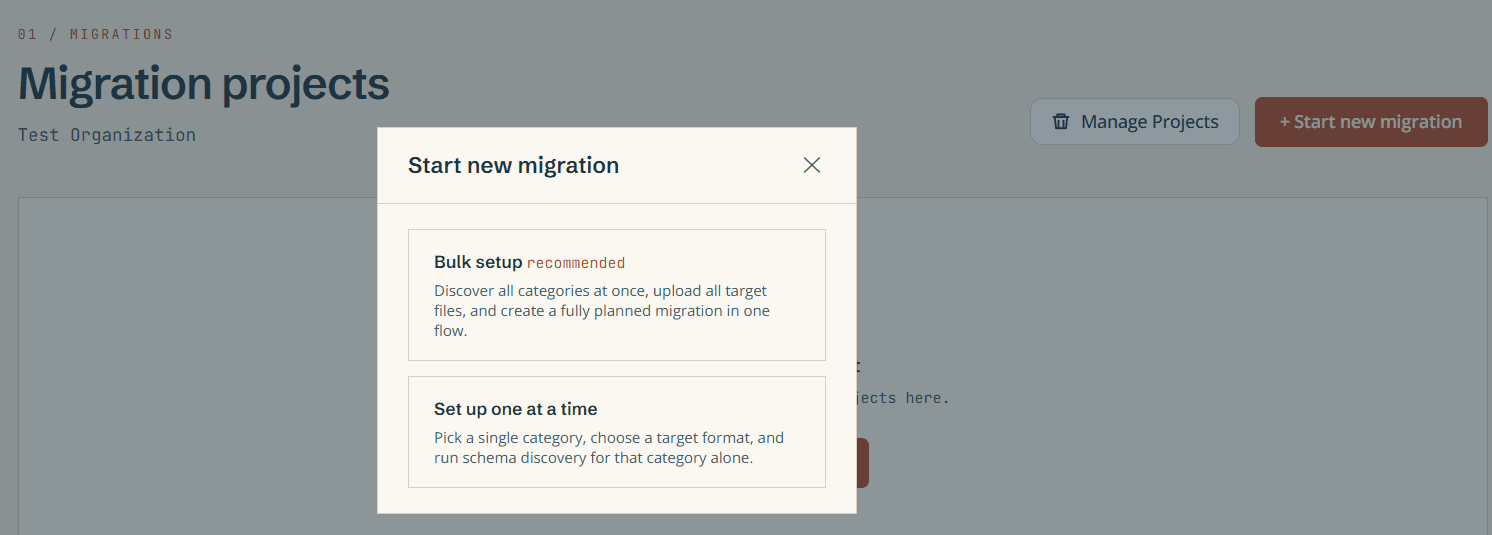
Step 02
Review and confirm AI-suggested field mappings
The schema explorer agent reads your source data and maps every field to its target equivalent — with a confidence score and plain-English reasoning for each suggestion. Confirm what looks right, override anything that doesn't.
Confirm or override every mapping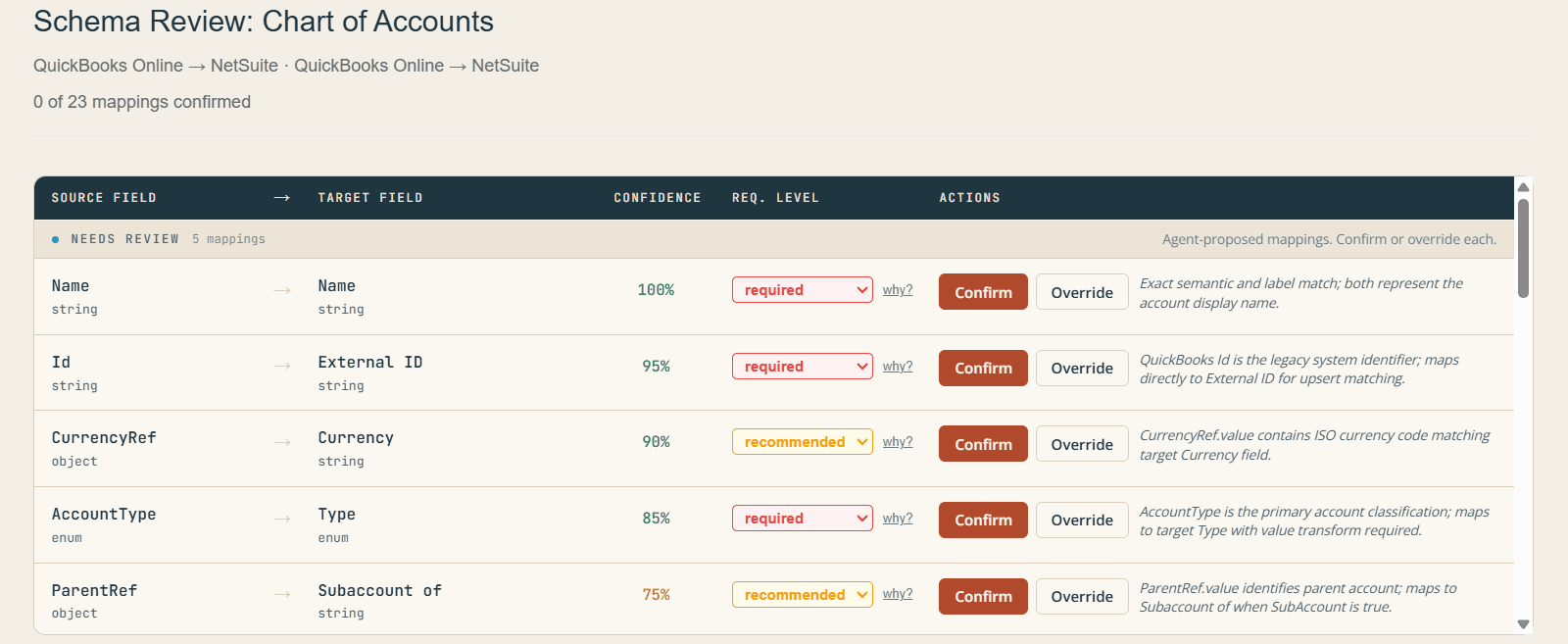
Step 03
Pull your data and run quality analysis
Once mappings are confirmed, Brock pulls live data from your source system and runs it through automated checks — surfacing missing values, duplicates, mismatched currencies, invalid formats, and stale records.
You approve before data is pulled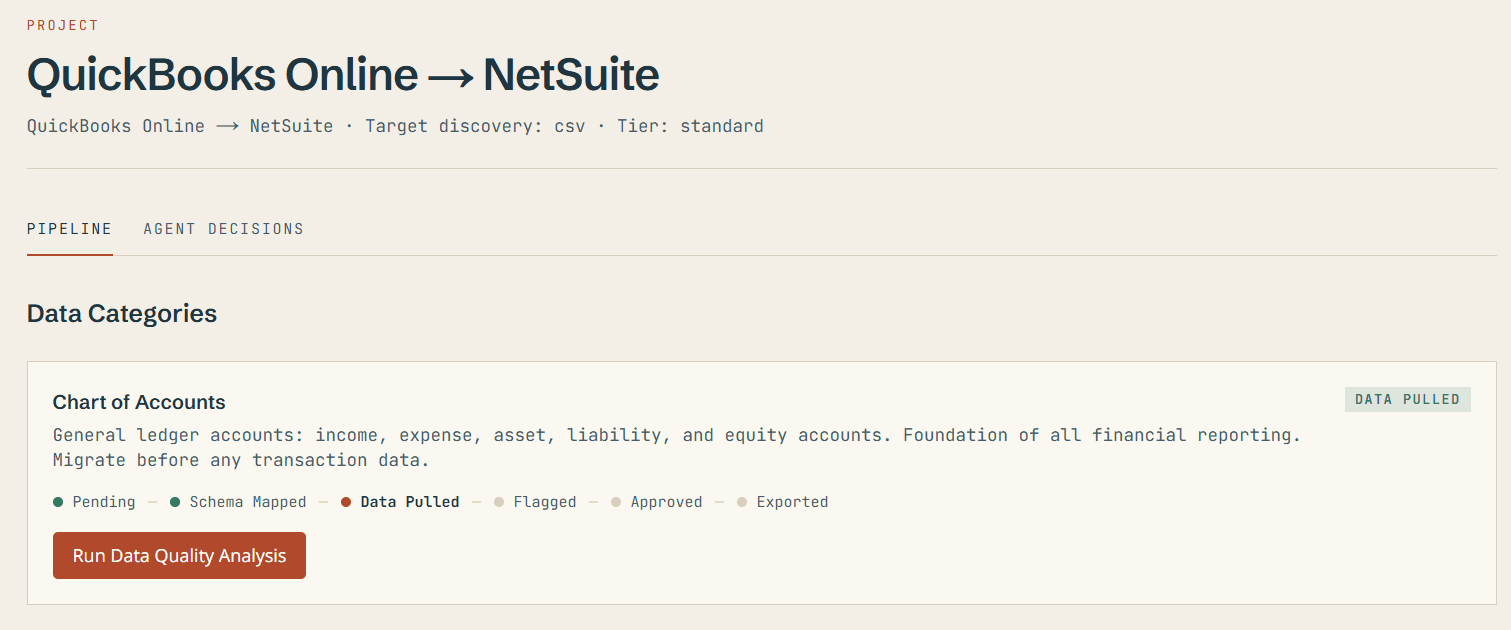
Step 04
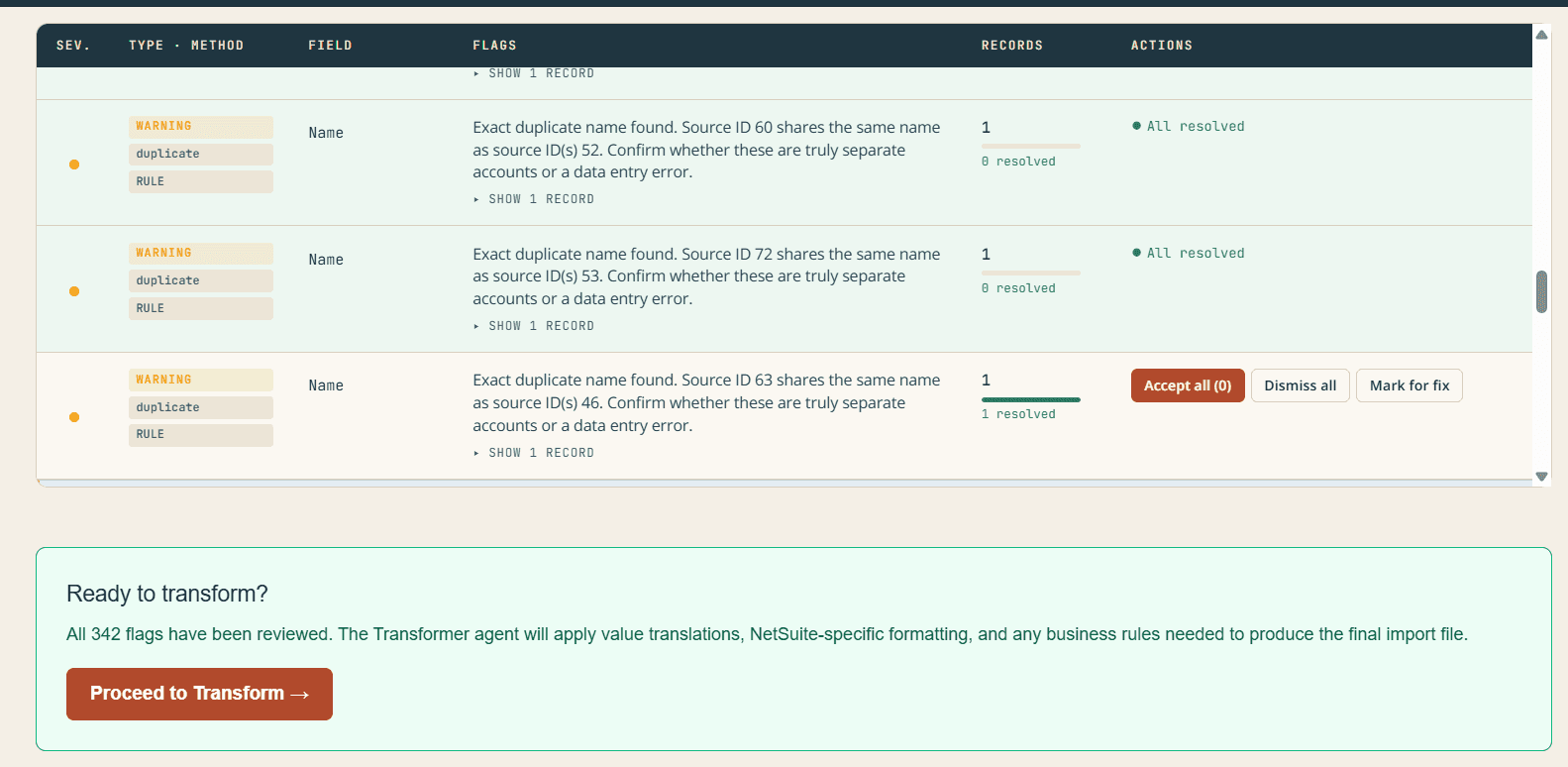
Resolve flags and approve your data
Every data issue is presented with context, severity, and a suggested resolution. Accept, dismiss, or mark for manual fix — row by row or in bulk. When all flags are resolved you approve the dataset and move to export.
You resolve every flag before export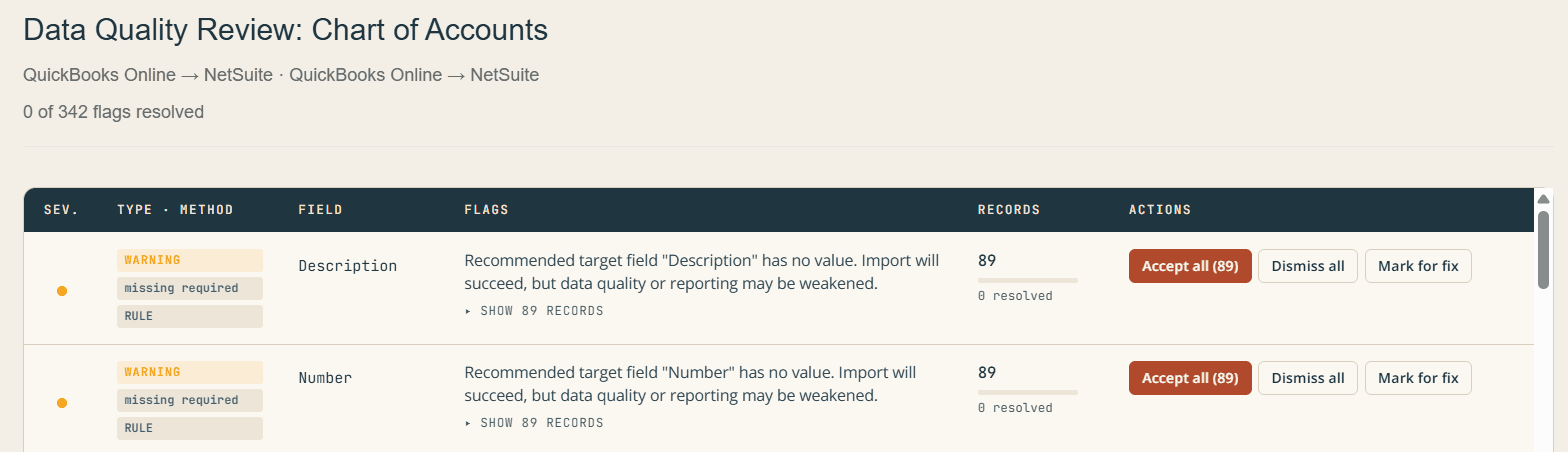
Step 05
Generate a clean export in your target format
Brock transforms and formats your approved data to the exact spec your target system requires, then generates a ready-to-import file. Download as CSV or XLSX, or connect directly via API for enterprise workflows.
You choose format and delivery method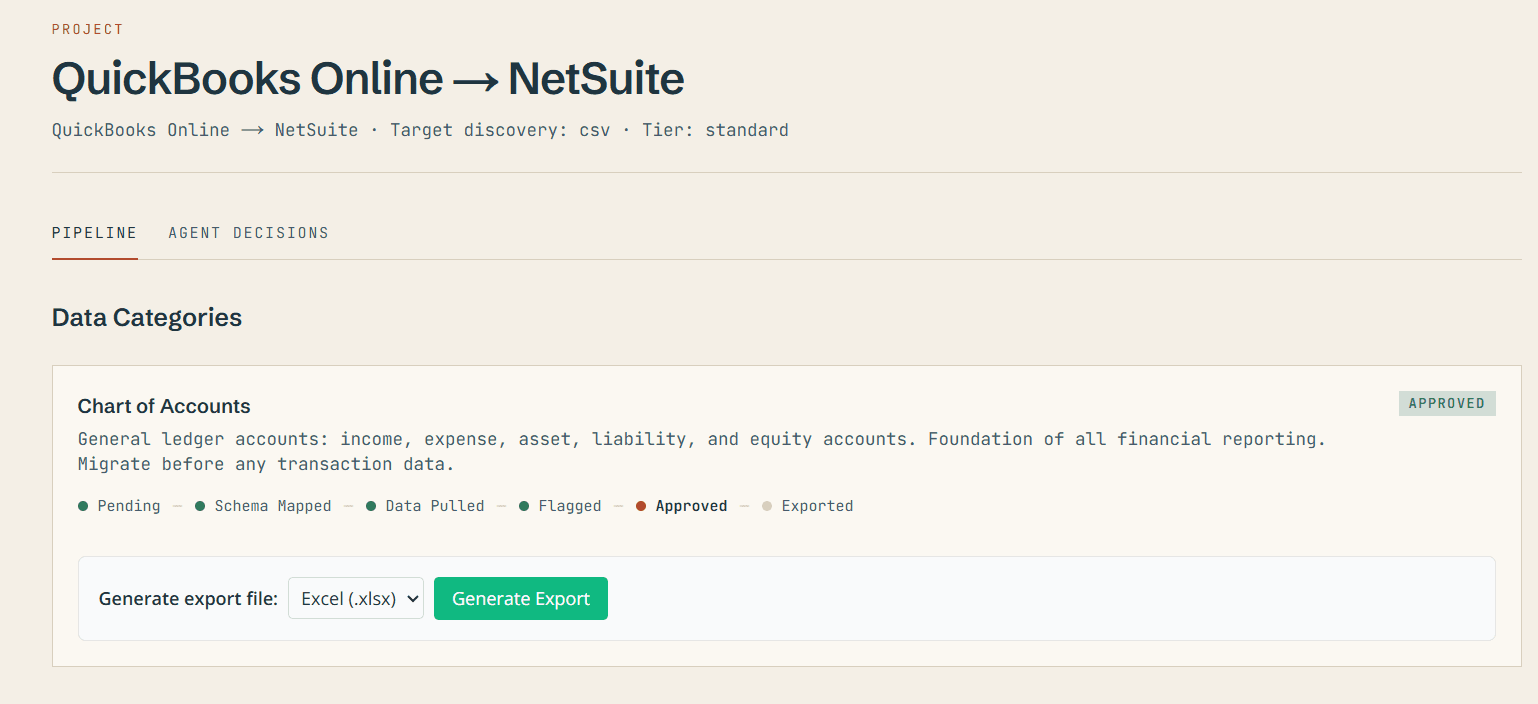
Every agent decision is logged and traceable.
See exactly what each AI agent proposed, what was confirmed, what was overridden, and by whom — across the full audit trail under Agent Decisions.
Built for how migrations actually work.
AI schema discovery
Three agents working together. No manual field mapping.
Flags, not errors
Surfaces decisions. You stay in control of every change.
Multi-currency support
Exchange rates, currency codes, and multi-currency balances migrate cleanly — no manual reconciliation.
Custom fields & configs
Different field names, bespoke structures, and program-specific configs are handled automatically. Your data model, not a generic one.
Snapshot + rollback
Every migration ships with a snapshot. Roll back with one command.
Static + transactional
Chart of accounts to vendor invoices. Full coverage on Pro.
Every organization gets its own agents.
When you sign up, Brock provisions a dedicated suite of AI agents scoped exclusively to your organization. Schema discovery, data quality review, and transformation agents never run across organizations — there is no shared model layer, no cross-tenant inference, no bleed.
Your agents can be tuned to your data patterns without risk of contamination from other users' data. You're not competing for inference capacity either — your migration is always deterministic.
Security isolation
Agents are provisioned at the org level. Cross-org requests are rejected at the infrastructure layer — there is no shared execution context.
Tunable per org
Field mapping preferences, quality thresholds, and transform behavior are all configurable per organization. Your settings don't touch anyone else's.
Data privacy
No migration data is used to train shared models. Your records stay inside your isolated execution context for the life of the project.
What a typical mid-market migration costs.
Without Brock
320+
consultant hours
14 weeks
typical timeline
With Brock
~40
consultant hours
Days–weeks
not months
Full breakdown with sources → see detailed comparison on pricing page
You don't have to.
If your migration is messier than a spreadsheet — transactional history, multiple entities, a hard cutover date — our team can take it on. Assisted, full-service, or advisory.
12-month data retention
Your migrated records are stored and retrievable for a full year while your plan is active. After cancellation, exports and agent decisions remain available for 6 months.
Automatic schema discovery
Runs automatically inside every migration project to map your source system — no manual configuration.
AI agents on every plan
Purpose-built AI agents for discovery, quality review, and transformation — more agents on higher tiers.
Flexible exports
Export as CSV, XLSX, or JSON (plan-dependent). Compatible with leading ERP targets and generic import tools.
14 days free. Cancel anytime.
Early access members get locked-in pricing for the lifetime of their subscription — meaning today's rate, forever, even as we add features. We have a limited number of early access seats available.
14-day free trial · cancel anytime
We’ve been in your seat.
Built by implementation veterans who’ve managed migrations for organizations of every size — and got tired of there being no better way.
The migration problem nobody talks about honestly
Every ERP implementation has a data migration. And every data migration has the same problem: someone who actually understands the data has to be involved, no matter what. That fact makes all three standard options more expensive than they appear.
If your company has someone who can run a data migration — a data manager, a systems analyst, a finance ops lead — they’re already doing something else. Pulling them into a months-long migration project doesn’t make that other work disappear. It delays it. And when you add up their loaded salary cost against the hours a migration actually takes, the “free” internal option isn’t free.
They know the destination system. They’re experienced, and that experience costs money — by the hour, by the day, by the phase. When the scope changes (and it always changes), the invoice changes with it.
The pitch is appealing: hand it off, get it back done. The reality is more complicated. External teams don’t arrive knowing your data — and your data has context that lives in your team’s heads, not in column names. A field called Type on a product record might mean something specific to your business that takes real back-and-forth to communicate. Every ambiguous mapping requires your input. Every output round needs your review. You’re not handing off the work — you’re managing a collaboration on top of your existing implementation load, while also paying for the privilege.
Brock exists because none of these options should be the only options.
The right process, built in
There’s a correct way to approach data transformation. It’s not magic — it’s methodology. Understand the source schema. Surface data quality issues before they become migration failures. Map fields deliberately, with the business logic documented. Validate output before it touches the destination system.
We know this process because we’ve run it. Brock doesn’t approximate it — it is it, automated.
Security by design, not by checkbox
Data migration means moving sensitive records — customers, vendors, financials, employees. Brock was designed from the start with the assumption that this data requires real protection, not a privacy policy and a promise.
Role-based category permissions mean your team members only see what they need to see. Your AR coordinator can work on customer data. They don’t need to see payroll. You set the boundary; Brock enforces it.
Every action in Brock is logged — who did it, what they did, when. Not for us. For you. When an implementation goes sideways, you need to know exactly what happened and when.
Row-level security is enforced at the database layer — not at the application layer where it can be bypassed. AI models never train on your data, and agents only ever see the specific fields they need to do their job — never your full records. Enterprise deployments route through private infrastructure.
Security isn’t a feature tier. It’s the foundation.
See what your migration looks like before you commit.
Run the estimate volume workflow. No account needed.